TL;DR
Across bridges USDC from Arbitrum directly to your Hyperliquid HyperCore account in about 2 seconds.
If you don't have a HyperCore account, Across initializes one automatically during the bridge.
A relayer fronts your collateral on arrival, so it's trade-ready before Arbitrum finalizes.
Across has never been exploited at the protocol level since 2021. Settlement runs on UMA's Optimistic Oracle, with V4 adding zero-knowledge proofs.
Arbitrum is where a lot of onchain trading capital already sits. It's deep in stablecoins, it's cheap to transact on, and it's where many traders keep their working balance between positions. Hyperliquid is where a growing share of that capital wants to go, to trade perps on a fully onchain order book. The trip between them is a chain crossing into Hyperliquid's own L1, and done the slow way it means routing through an exchange and waiting while the market moves.
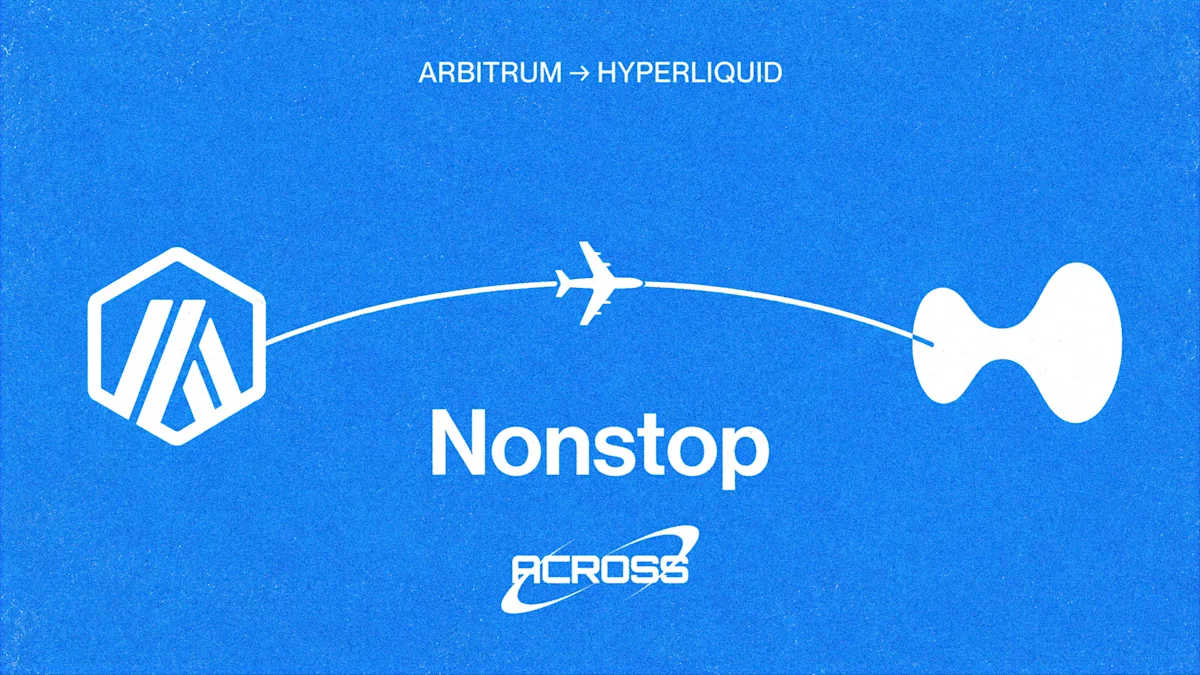
Across bridges Arbitrum to Hyperliquid in one transaction, in about two seconds, straight into your HyperCore account.
A Relayer Credits Your HyperCore Account Directly
Hyperliquid runs on its own L1, with HyperCore as the trading layer and HyperEVM as the execution layer beneath it. Bridging in means getting funds onto that stack and into a HyperCore account before you can place an order.
Across handles the whole path. You deposit USDC on Arbitrum, a relayer fills on HyperEVM, and the funds are credited to your HyperCore account automatically. If you don't have a HyperCore account yet, one is created during the bridge; there's no separate setup. The relayer fronts the capital and carries the finality risk, so your collateral is trade-ready in about 2 seconds rather than after Arbitrum finality plus a deposit queue.
Bridging Arbitrum to Hyperliquid, Step by Step
Go to across.to/hyperliquid-bridge and connect your Arbitrum wallet as the origin.
Select Arbitrum as the origin chain and USDC as the token you're sending.
Select Hyperliquid as the destination. Across routes the funds to your HyperCore account.
Confirm in your wallet. Funds land in HyperCore in about 2 seconds, ready as trading collateral.
Speed and Safety Are the Only Two Things a Funding Route Owes You
For a trader, the bridge isn't the point; the position is. What matters about a funding route is how fast collateral arrives and whether it arrives at all. A slow bridge means watching a setup slip away on a pending screen. Across credits HyperCore in about 2 seconds, so the gap between deciding to trade and being funded is measured in seconds, not confirmation windows.
The second point is the security record. Across has processed billions in volume since 2021 without a protocol-level exploit, settled through UMA's Optimistic Oracle where a single honest challenger can reject a bad bundle, with V4 adding zero-knowledge proofs through Succinct's SP1. Collateral headed toward leverage shouldn't carry bridge risk on top of market risk.
The Fee Is Quoted Up Front, With No Hidden Spread
Across quotes a relayer fee and a small LP fee before you confirm, scaled to size and route, with no spread baked into the rate. Settlement batches into one bundle roughly every 90 minutes, so the gas of clearing the crossing is shared across everyone in it.
Arbitrum is where trading capital rests. Across moves it onto Hyperliquid in the two seconds before a setup goes stale.