
TL;DR
Across Protocol provides the easiest way to bridge USDC between chains. It is the first crosschain bridge to offer auto-finalized CCTP V2 transfers for USDC, meaning users only need to complete one transaction instead of two. Across supports USDC transfers up to $10 million across Ethereum, Arbitrum, Base, Optimism, and seven other chains. Intelligent routing selects between fast relayer fills (for smaller amounts) and CCTP V2 (for larger amounts) without user intervention.
Introduction: The Need for Smoother USDC Experiences
You need to move USDC across chains. Maybe you're rebalancing a treasury, funding a trade on another network, or chasing better yield. It should take seconds.
Instead, you're stuck with a two-step process. Every app and bridge that supports native USDC transfers asks you to do the same thing: initiate a transaction, wait for attestation (sometimes 15+ minutes), then manually claim your funds on the destination. Two transactions. Two gas fees. And you can't step away because the claim window will eventually expire.
This is USDC, the most trusted stablecoin in DeFi. Why does moving it feel like filing a tax return?
The underlying technology, Circle's CCTP V2, is genuinely impressive. But every implementation so far has passed the complexity to users.
So we decided to make USDC bridging easy for everyone.
USDC: The Crosschain Stablecoin
Stablecoins have reached their highest-ever annual transaction volume, rising 83% between mid-2024 and mid-2025. USDC in particular has become the backbone of crosschain commerce.
As of early 2025, USDC's market cap has nearly doubled year-over-year, growing from $28.5 billion to over $56 billion. Active USDC addresses grew nearly twofold, from 3.8 million to 6.8 million in just twelve months. From treasury operations to crosschain swaps to emerging market remittances, USDC is often the asset people reach for when they need stability and liquidity.
Circle, the company behind USDC, built something genuinely impressive to help move it between chains: the Cross-Chain Transfer Protocol, or CCTP. The latest version, CCTP V2, represents the gold standard for native stablecoin transfers.
So what makes CCTP V2 so powerful?
How CCTP V2 Works
Most bridges lock your tokens on one chain and mint a "wrapped" version on another. You're not really moving USDC; you're creating a synthetic representation backed by tokens in a smart contract. This introduces trust assumptions and liquidity fragmentation.
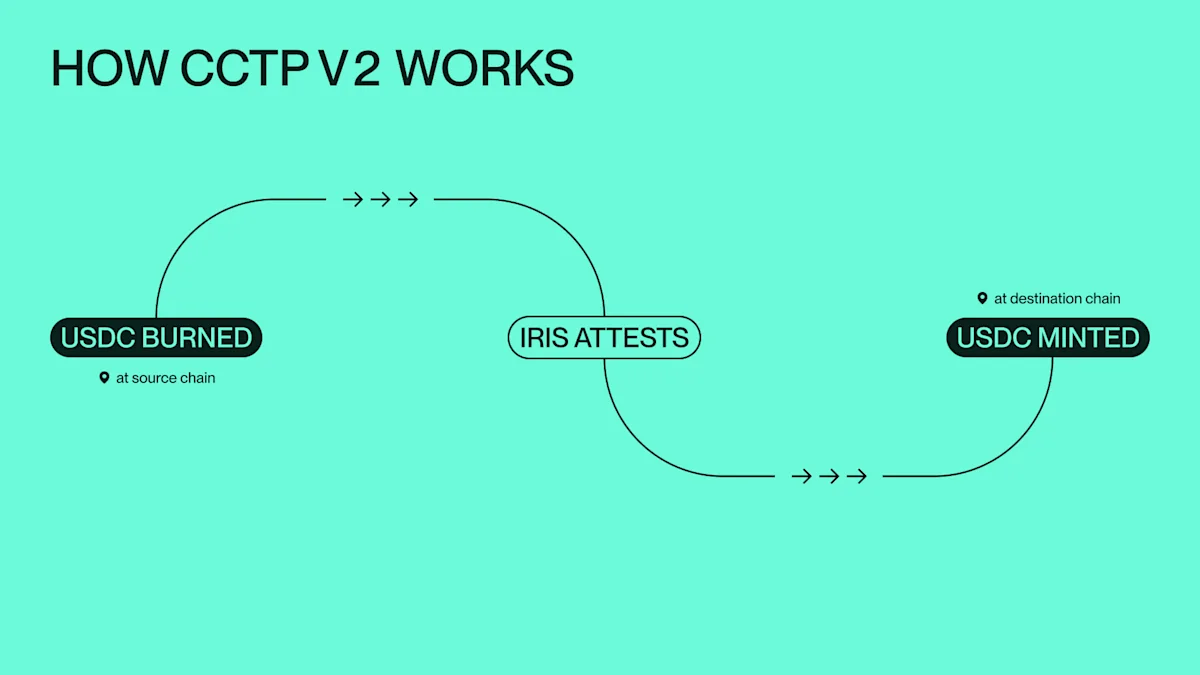
CCTP V2 is built differently. When you transfer USDC, the tokens are burned on the source chain. Circle's attestation service (Iris) cryptographically confirms that burn. Then the exact same amount is minted fresh on the destination chain. Native USDC on both ends. No wrapping, no synthetics. The USDC you receive is the real deal.
It's an elegant infrastructure. But until now, most apps that integrated CCTP V2 have required users to complete the process manually: initiate the burn, wait for attestation, then submit a second transaction to claim your minted tokens. For a $50 transfer, this is annoying. For a $5 million transfer, it's an operational burden.
We saw an opportunity to deliver the CCTP V2 experience the way it should be.
Across Protocol: A Better Way to Bridge USDC With CCTP V2
At Across, we believe infrastructure should be invisible to users. That principle guided our CCTP V2 integration. Here's what we did:
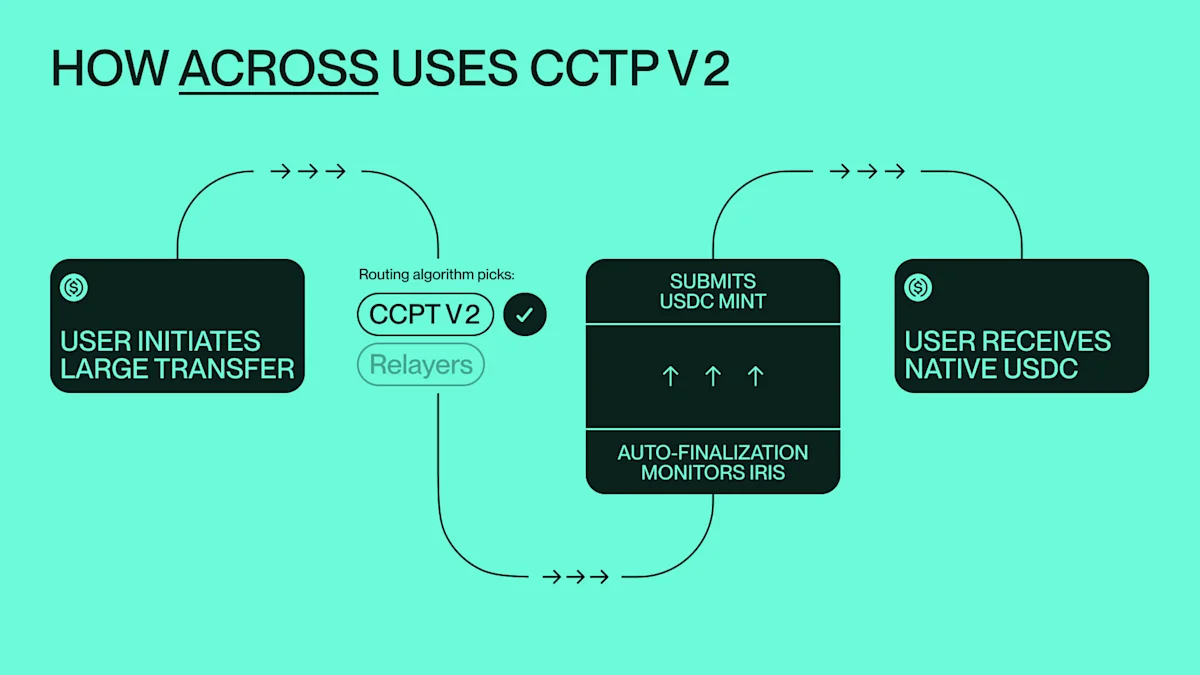
We eliminated the second transaction. When our routing algorithm selects CCTP V2, you initiate a single transaction. Our finalizer infrastructure monitors Circle's Iris API, and once your transfer is attested, we automatically submit the mint transaction on your behalf. Your native USDC arrives without further action.
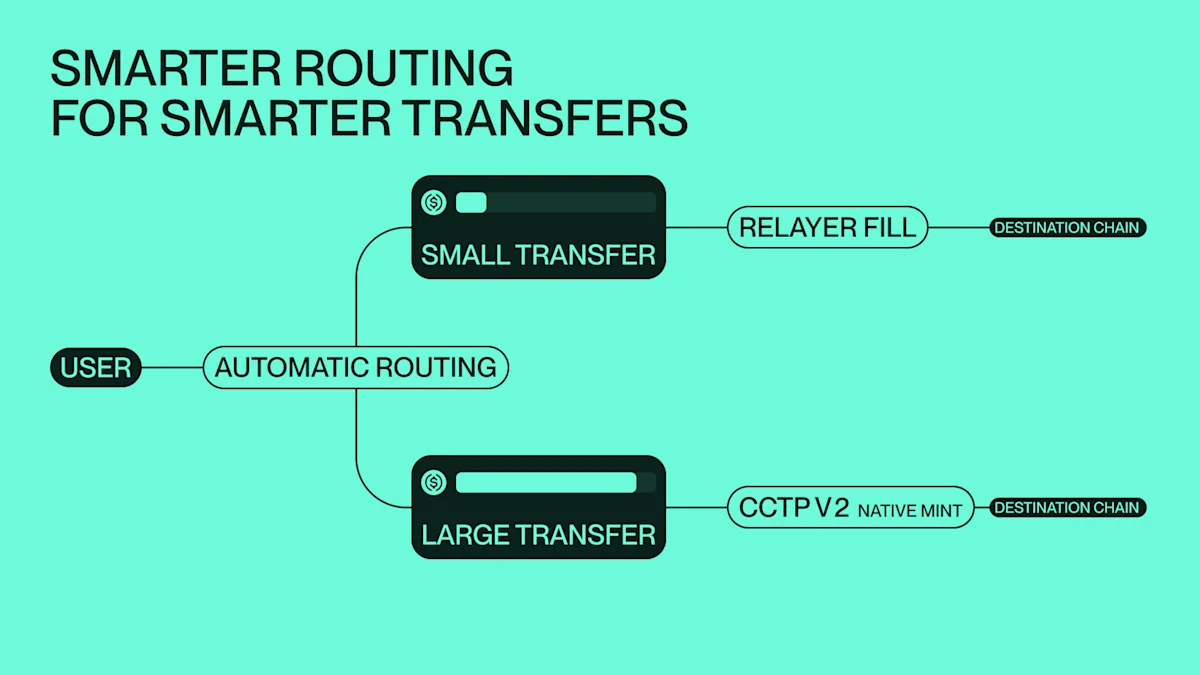
We built intelligent routing that optimizes for the user. Not every transfer should go through CCTP V2. For smaller amounts, our relayer network fills transfers in seconds, faster than waiting for attestation. For larger amounts that exceed relayer liquidity, CCTP V2 becomes the better path. Our system evaluates each transfer and selects the optimal route automatically.
Plus, every transaction is fast, cheap, and secure. You enter an amount, confirm one transaction, and receive your USDC where you want it, when you want it.
What Happens Under the Hood
When our routing algorithm chooses CCTP V2, your transaction burns USDC on the source chain. From there, our auto-finalization system takes over. It continuously monitors Circle's Iris API for attestations, and once Iris confirms your burn, it automatically submits the mint transaction on the destination chain. Native USDC lands in your wallet without any further action.
The whole system runs in the background. You just see one transaction and USDC arriving.
Why USDC Transfer Size Matters
Across works for any transfer size, but CCTP V2 integration becomes especially valuable as amounts grow in size.
Our relayers settle most transfers in seconds. But relayer capacity is bounded by liquidity. A relayer can only fill a $500,000 transfer if they have $500,000 ready to deploy. This system is perfect for everyday transfers, but can struggle when whale-sized amounts of funds need to be bridged.
Meanwhile, CCTP V2 has no liquidity dependency. Circle mints whatever was burned, up to protocol limits. This means Across can support transfers of up to $10 million in a single transaction through the CCTP V2 path.
The experience stays consistent: enter $1,000 and get an instant relayer fill; enter $3 million and the system routes through CCTP V2. One transaction either way, funds arrive, no manual intervention.
Things to Keep in Mind
We'll be direct: CCTP V2 attestation times vary by chain. Relayers typically settle in seconds. CCTP V2 can range from a few seconds to 15+ minutes depending on the source chain and transfer mode.
But for larger transfers, CCTP V2 offers guaranteed execution without liquidity constraints. And because we auto-finalize, the wait is passive for you. No dashboards to monitor, no claims to remember.
On cost, we optimize automatically. CCTP V2 Fast mode offers quicker attestations with a small fee. Standard mode offers zero bridge fees, and on chains like Polygon, Monad, and HyperEVM, Standard mode attestation is already fast (under 10 seconds). Our routing picks the best option for each transfer based on the specific chain and amount.
What This Means for You
If you're bridging USDC:
You only need to complete one transaction.
The claiming step has been completely removed from the process, there is no second gas fee, and you don't need to track attestation status.
It works the same whether you're moving $100 or $10 million. You always receive native USDC, not a wrapped version.
You get Across’ speed, cost-efficiency, and security with every transfer.
If you're building crosschain apps:
The Swap API abstracts everything. One endpoint, one transaction object, regardless of whether the path uses relayers or CCTP V2.
You don't need to build attestation monitoring, there is no finalization logic to implement, and there are no routing decisions to manage.
Your users get to enjoy one-click crosschain experiences directly within your app.
Explore our Swap API docs to start building.
Supported Chains
CCTP V2 through Across is live on: Ethereum, Arbitrum, Base, Optimism, Unichain, World Chain, Linea, HyperEVM, Monad, and Polygon.
Solana is supported as an origin chain, with destination support coming soon.
We use Fast mode where available and Standard mode on chains where it enables zero bridge fees.
How to Bridge USDC with Across
Bridging USDC between chains with Across is incredibly easy. Here’s how you do it:
Go to app.across.to
Connect your wallet
Select your source chain and USDC as your source token
Select your destination chain and USDC as your destination token
Enter the amount
Confirm the transaction
That's it. No second transaction, no claiming step. Your native USDC arrives automatically in seconds.
The Bigger Picture: A New Standard for USDC Bridging
This CCTP V2 integration reflects how we think about everything at Across: infrastructure should get out of the way of onchain experiences.
Users express the outcomes they want, and the system takes care of the rest. Complexity stays hidden. This approach has powered over $35 billion in crosschain volume without a security incident or protocol downtime.
Moving money across chains has never been easier.
Join the Across community:
Twitter | Discord | Telegram | Farcaster | Hey.xyz | LinkedIn