A comparison from a team that builds one of them.
Search "best crypto bridge" and you will find a dozen ranked lists that mostly agree with each other. Across is usually near the top of them, so we have no complaints about the scoreboard, but since our product has evolved we’re taking a new look at the categories.
Almost every one of those lists describes a market that stopped existing around 2024. They compare bridges as if they were interchangeable products competing on a single axis — how fast, how cheap — and they slot each one into a lane: this one is for L2s, that one is for Solana, this one is for size. Several of them describe Across as a fast, cheap way to move a few thousand dollars between Ethereum rollups. That was accurate. It is now about a third of what Across does.
So this is our version of the list. We build one of the bridges on it, and we are going to tell you where we think we win. We are also going to tell you, specifically and by name, where you should use something else. Every claim below is either sourced or marked as ours to prove.
First: "bridge" is no longer one category
The single most useful thing that happened to this market in the last two years is that it split into layers. Getting the layers straight resolves most of the arguments about which bridge is "best," because the honest answer is usually that the two things being compared are not competitors.
Rails are the primitives that actually move value between two chains. Circle's CCTP burns USDC on the source chain and mints it on the destination; canonical, no wrapper, no third-party liquidity. LayerZero OFT gives a token a single omnichain supply, which is how USDT0 and a long list of project tokens travel. Canonical bridges are the rollup's own escrow contract, slow but maximally trust-minimized. Paxos Labs' Amplify Transit converts between regulated stablecoins at a rate locked when you submit. Rails are not products you shop for. They are plumbing, and each is excellent at exactly one thing.
Execution layers decide which rail a given transfer should take, front the capital so you do not wait for the rail to finalize, and hand you the asset. Across, Relay, and deBridge live here.
Aggregators and apps — LI.FI and its Jumper app, Squid, Rango — sit on top, comparing execution layers per quote and presenting one button.
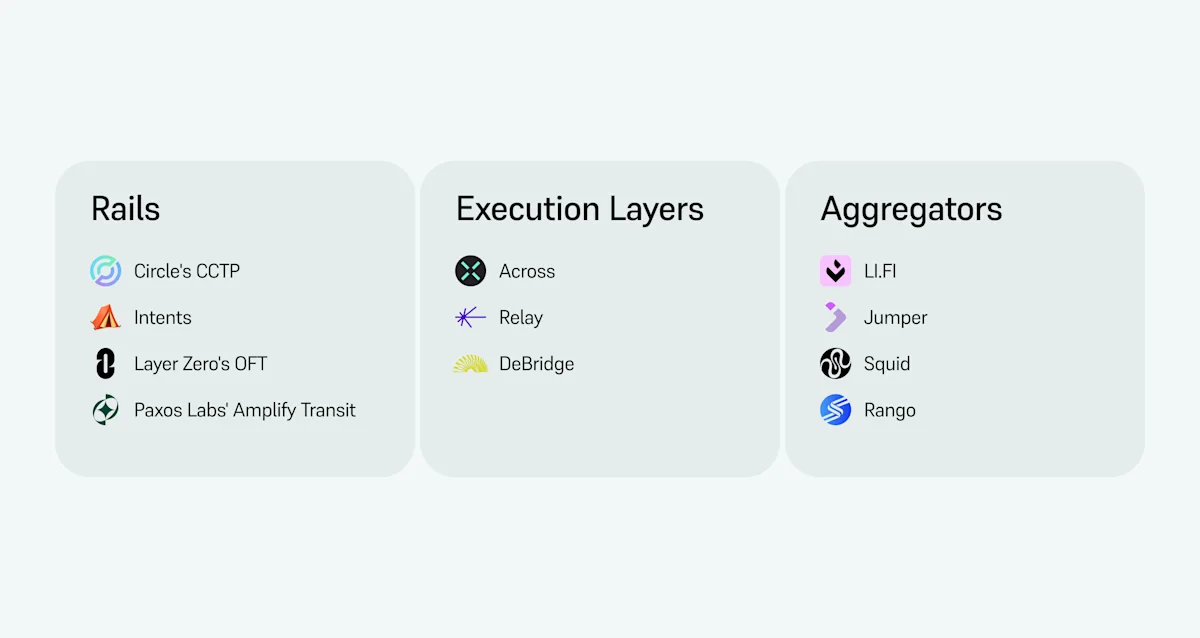
A list that ranks CCTP against Jumper is comparing a rail to a storefront. Keep the layers separate and the rest of this gets much easier.
How we are judging
Six criteria. We picked them before we wrote the entries, and two of them are ones Across does not win.
Time to usable funds. Not "time to finality", but time until the asset is in your wallet and spendable.
Cost, and how cost behaves as size grows. A bridge that is cheap at $500 and ruinous at $500,000 is a different product than one that is flat.
Maximum practical transfer size. Where does the quote start getting worse, and where does it stop being offered?
Coverage. Chains, and just as importantly, assets. USDC coverage is table stakes; USDT, project tokens, and non-EVM are where lists diverge.
Honesty threshold. How many parties have to stay honest for your money to be safe? One? A multisig quorum? A validator set?
What arrives. Native asset or wrapper. Guaranteed output or a quote that can move.
A note on numbers before we start. Every count in this piece moves. Where a project's own published figure differs materially from what its own public API or a neutral tracker returns, we give you both and say when we checked. That includes our own.
The bridges
Across — execution layer, intents over several rails
Best for: EVM and Solana transfers where you want the fastest usable funds, and — this is the part that changed — large regulated-stablecoin movements where the fee should not scale with the size.
Across takes a signed intent describing what you want, and a permissionless network of relayers competes to front you the destination asset immediately from their own capital. Settlement happens behind you, in batches. Because the relayer is racing a competitor rather than waiting for a rail to finalize, you get funds fast: Across publishes a 1.2-second average from confirmation to funds in your wallet, with most transfers landing in under two seconds. As of September 2026 we can report $40B+ moved and 5M users, across 22 chains.
Here is what the older comparisons miss. Across is not a single-rail bridge any more, and which rail you travel depends on the asset and the route:
Intent fills are the default, because they are usually the fastest.
Circle's CCTP sits underneath USDC flow as the settlement and rebalancing layer, which is why USDC arrives as real USDC rather than a bridged stand-in.
The OFT path carries USDT0 directly, burned on the origin chain, minted on the destination.
Paxos Labs' Amplify Transit carries large regulated-stablecoin conversions.
The size story changed in August. Through the Amplify Transit integration, Across now quotes single transfers up to $50 million into and out of Robinhood Chain, converting USDC to USDG in both directions. On those routes the rate is locked at submission, so the output is known before settlement, and the fee is fixed per route whether the transfer is $50,000 or $50 million. Robinhood Chain is the clearest illustration of why a second rail matters: it does not appear on Circle's CCTP supported-chains list, and its canonical withdrawal carries a challenge period of roughly seven days, so without Transit recycling inventory there is no fast path off it at size at all.
Note the scoping, because it matters: the $50M ceiling, the locked rate and the fixed fee are properties of Transit routes into and out of Robinhood Chain, not of every Across route, and not yet of every stablecoin. On a standard intent route you get a quote upfront that reflects relayer competition and destination gas.
Honesty threshold is the strongest structural argument for Across and the least discussed. Across settles optimistically, and our docs call the result a 1-of-N trust assumption: the system only requires a single honest actor to dispute an invalid proposal in order to stay secure. Anyone can be that actor: no permission, no seat, no stake in a validator set. Compare that to a bridge whose safety depends on a fixed key quorum staying uncompromised.
Where it is weaker: chain count. 22 chains is not 60, and it is not 89. Across focuses on stablecoin-heavy chains with proven demand, so if your destination is an obscure or brand-new chain, Across may simply not be there, and a broader router will be. Non-EVM coverage is real but narrower than the EVM footprint: Solana, Hyperliquid and TRON are supported; most other non-EVM ecosystems are not.
Relay — execution layer, solver network
Best for: the long tail of chains, and small transfers to places nobody else has gotten to yet.
Relay runs a solver model with a similar user-facing shape to Across: a solver uses its own capital to complete the action on the destination chain, and reconciliation happens after, through an escrow, an oracle attestation and a hub ledger. Relay markets 85+ networks; its own public chains API returned about 60 mainnet chains when we checked on 2026-09-21, which is still comfortably more than we cover. It publishes a 99.9%+ fill success rate with sub-3-second median fills on supported routes, and a fast origin-chain refund when a fill fails: net of gas, not always in the asset you started with, and skipped entirely when the refund would cost more than it is worth.
Credit where it is due: on chain coverage Relay is ahead of us and has been for a while. If you are moving a small amount to a chain that launched last month, Relay is often the only execution layer that quotes it at all.
deBridge — execution layer, poolless order flow
Best for: guaranteed-rate native transfers where you want no pooled liquidity in the settlement path.
deBridge's genuinely good idea is DLN, its order-based layer, which holds no pooled liquidity: solvers fill from their own capital and the contracts act as pipes rather than pools. There is no honeypot to drain, which removes the specific failure mode behind a large share of historical bridge losses. Rates are guaranteed with no slippage and native assets are delivered. deBridge publishes a 1.96-second median settlement, and its docs describe typical end-to-end completion in under two minutes.
Two points of precision, offered in the spirit of not wanting the same done to us. The poolless property is DLN's; deBridge's older dePort product still locks natives and mints synthetic deAssets, and neutral trackers still show a small TVL figure against the protocol. And the unlock messaging underneath DLN inherits the deBridge messaging protocol's multi-validator consensus, so the honest description of the honesty threshold is "permissionless solvers for the fill, an elected validator set with a signature threshold for the unlock," not "no trusted parties anywhere."
deBridge publishes its own 2026 bridge guide, which ranks deBridge first. We are doing the same thing here, so we will not be precious about it, the poolless argument is a real architectural claim and worth reading, from them or from anyone.
Stargate — rail plus front end, pooled liquidity and OFT
Best for: USDT, and chain breadth.
Stargate is the most prominent front door to LayerZero's OFT world. Its own docs put reachable chains at 89 and the LayerZero transfer API returns more than a hundred, though the number of chains where Stargate actually holds pooled liquidity is smaller: neutral trackers put that in the twenties to forties. Worth knowing which you are getting: on core chains a Stargate pool locks and unlocks the native asset, while on its newer "Hydra" chains you receive a backed representation rather than the native token. On breadth it is well ahead of us, and if your destination is one of the chains we do not cover, this is your route. Speed depends on the path: sub-second on its newer fast-swap routes, roughly twenty seconds on a fast source chain, up to a few minutes on a thin pooled route.
One correction to the received wisdom, though, because it appears in most of the lists: USDT is no longer a weak spot for Across. USDT0 routes through the OFT path directly, burning on the origin chain and minting on the destination. It still carries a bridge fee like any crosschain transfer, quote it rather than assuming. Comparisons written a year ago will tell you to use Stargate for USDT by default. Quote both.
Circle CCTP — rail
Best for: USDC when canonical correctness matters more than convenience.
Burn on one side, mint on the other. No wrapper, no third-party liquidity, and no liquidity counterparty beyond Circle. CCTP V2 covers 30 mainnet chains, including Ethereum, Base, Arbitrum, Optimism, Polygon, Avalanche and Solana.
The "CCTP is slow" line in most comparisons is out of date and worth unpicking, because it is the kind of thing we would want corrected about us. CCTP V2 has two modes. Standard Transfer waits for hard finality: about fifteen to nineteen minutes on Ethereum and its L2s, but about eight seconds on Polygon and Avalanche, where hard finality is already fast. Fast Transfer attests at soft finality instead and lands in roughly eight to twenty seconds depending on the source chain, for a fee of zero to thirteen basis points. Either way you are waiting on a Circle attestation; the difference is which finality it is issued against, not whether an attestation exists. For treasury operations with a compliance requirement to hold only canonically-minted USDC, that dependency is a feature.
Two things to keep in view. The attestation service is a hard dependency with published rate limits and circuit breakers, and the attester quorum is two of two, both Circle's. And CCTP V1 is being retired: burn limits drop on 2026-10-31 and the contracts pause on 2026-12-01, so anything still on V1 needs to move.
You can use CCTP directly. You can also get USDC through Across, where CCTP does the settlement and rebalancing underneath while a relayer fronts you the funds immediately, so you do not wait out the attestation at all.
LI.FI, Squid, Rango — aggregators
Best for: not having to read this article.
Aggregators quote several execution layers per route and pick. LI.FI runs the Jumper app as its consumer front end, so treat those as one company rather than two options. Squid was incubated in the Axelar ecosystem and now runs its own stack. If you have no strong opinion, an aggregator is the correct default, and it is also the fairest referee in the market: an aggregator has no reason to prefer any of us except on the quote. We are comfortable being measured that way.
The table
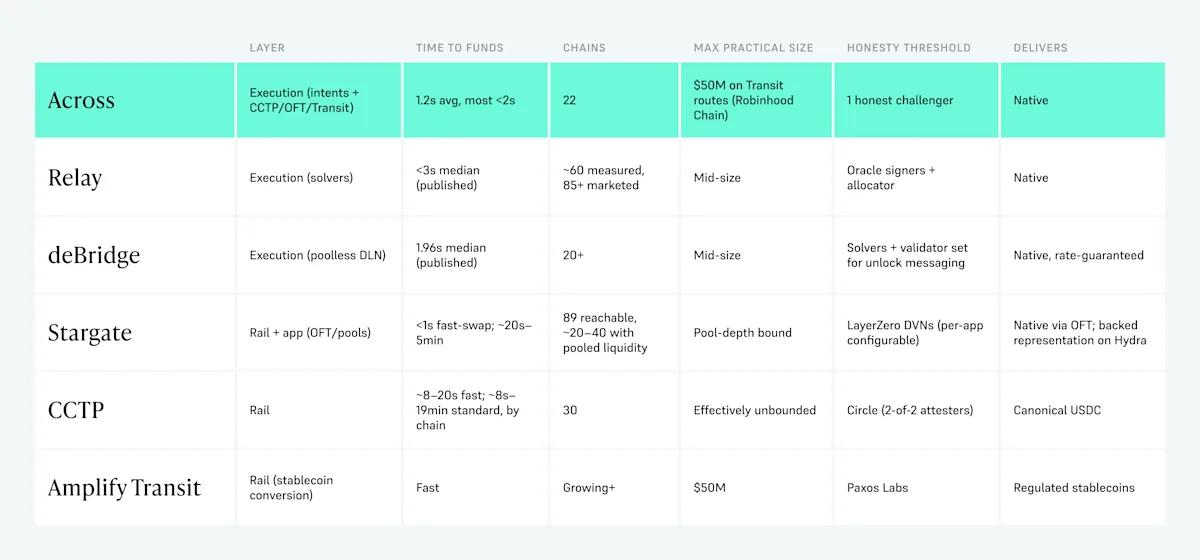
All figures checked 2026-09-21. Speeds are typical route observations, not guarantees. Verify current numbers before relying on them, see the last section.
What actually changed about Across
Three assumptions in the older comparisons are now wrong, and it is worth stating them plainly rather than hoping the table does the work.
"Across is single-rail by design." This was true in the past. Today, it is not. Intent fills are the default because they are the fast path, but USDC settles over CCTP underneath, USDT0 travels the OFT path, and large regulated-stablecoin conversion runs over Amplify Transit. The routing decision is the product.
"Across is for small, fast transfers." The $50M ceiling on Transit routes is a different order of magnitude, and the fee on those routes does not scale with size. The thing that makes Across good at $500 –competitive relayers racing to fill– is not the thing that makes it work at $50M. Those are separate rails serving separate flows, and the API picks between them without integrators changing anything.
"Across is EVM L2s." Solana, Hyperliquid, TRON, and Robinhood Chain since that chain's launch. Still 22 chains, not 89. But "Ethereum and its rollups" undersells it by a lot.
Older descriptions of Across were likely true when they were written, but as we've evolved it's time for an update.
Pick by the job, not the ranking
Moving USDC between major EVM chains, want it now → Across, or any aggregator, which will probably route to us or Relay.
Moving $1M+ in stablecoins into or out of Robinhood Chain → Across via Amplify Transit. Elsewhere, CCTP if you need canonical minting and can wait, or an intent route if you want it now.
Moving USDT → quote both. USDT0 goes over the OFT path either way; Stargate wins on chains we do not reach.
Destination is an obscure or very new chain → Relay, or an aggregator.
You are a protocol treasury with a compliance mandate → Use Across, CCTP directly, or Amplify Transit for regulated stablecoin conversion. Speed is not your constraint, but Across will give you the best route possible.
You want no pooled liquidity in the settlement path → deBridge's DLN.
You are moving into Hyperliquid to trade → Across. The routing from HyperEVM into your HyperCore account is handled for you, so there is no second step to do yourself.
Check the data
Everything above is verifiable, and you should verify it, including the parts that flatter us.
Volume and route share: DefiLlama's bridge dashboards, and aggregator-level route-win data from LI.FI and Jumper; a neutral aggregator choosing between us on every quote is a better signal than anything either of us publishes.
Security: OpenZeppelin's published Across audits, and our own security-model page for the 1-of-N argument.
Chain counts: every project's own public API, not its marketing page. That is how we got the numbers in this piece, ours included, and it is why several of them are lower than the figures you will see elsewhere.
Speed and cost: quote the same route on three of these at the same moment. It takes two minutes and beats any table, including ours.
PeckShield counted fourteen bridge exploits totalling about $341 million in the first five months of 2026, and the total has grown since. The largest single one, in April, was not a broken quorum, it was a configuration with only one verifier in it, which an attacker worked around to make a bridge act on a message no chain had ever emitted. Cause and blame there are publicly disputed between the projects involved, so we will not adjudicate it. The point that survives the dispute is the one worth taking away: the honesty threshold is not an abstraction, and a low threshold on paper does nothing if the deployment sets it to one. When you evaluate any of the options above, ours included, ask how many parties have to stay honest, whether that number is enforced or merely configured, and treat every other number as secondary.
Across is an execution layer for crosschain transfers, routing intents over a relayer network, Circle's CCTP, LayerZero's OFT path and Paxos Labs' Amplify Transit across 22 chains. $40B+ moved, no user funds lost to a protocol-level failure. across.to